When to See the Matterhorn: Seasons, Cloud and the Best Time of Day
The Matterhorn is one of the most photographed mountains on earth, and one of the most elusive. Plenty of visitors travel to Zermatt, ride up to a viewpoint and see nothing but cloud. The mountain is not hard to reach; it is hard to catch in the open. The good news is that a little planning — the right season, the right time of day and enough days in hand — improves your chances enormously.
This guide covers the seasons in Zermatt, the lift timetables that shape your options, the best times of day, how long to stay and what to wear when you get to the top.
Why the Matterhorn is so often hidden
The Matterhorn stands on its own, a steep pyramid rising to 4,478 m, and it catches the weather. Cloud often gathers around the summit even on days when the valley is clear, and it can form or lift within minutes. That is why two visitors on the same day can come home with very different photographs.
The practical consequences are simple:
- A clear sky from the village is your signal to go up. If you can see the peak from Zermatt, act on it.
- Do not fix your viewpoint for one particular day if you can avoid it.
- Give yourself more than one chance. The more mornings you have in Zermatt, the better your odds.
The seasons in Zermatt
Zermatt is a year-round resort, and the Matterhorn can be seen in every season. What changes is what else is happening around it, and which lifts are running in which form.
Winter
In winter Zermatt is a ski village, and the Gornergrat is at the heart of the Zermatt ski area. The lifts carry skiers as well as sightseers, and the Matterhorn above a snow-covered landscape is one of the classic winter views in the Alps.
Winter suits visitors who want the snow-covered mountain and do not mind the cold. Dress for serious cold at the viewpoints, and expect the lifts and trains to be busy with skiers.
Spring
Spring is the season of changeover. The Gornergrat railway’s main timetable starts on 20 April in 2026, and at Glacier Paradise the summer skiing season begins on 4 May. Snow lingers at altitude, and the valley slowly turns green.
For sightseers, spring can be a quieter time to visit, but check timetables carefully around the changeover dates.
Summer
Summer is the busiest season. The Gornergrat’s summer timetable runs from 20 April to 1 November 2026, with trains every 24 minutes from 08:00 and the first train from Zermatt at 07:00. It is the season of hiking, of walking between the Gornergrat’s intermediate stations, and — remarkably — of summer skiing at Glacier Paradise, which runs from 4 May to 31 October 2026.
Summer gives you the longest days and the most options. It also brings the most visitors, so the early trains are the quietest.
Autumn
Autumn is the other quiet season, with fewer people on the lifts than in summer. It is also when you need to watch the calendar most closely:
- The summer ski season at Glacier Paradise ends on 31 October 2026.
- The Gornergrat summer timetable ends on 1 November 2026.
- The Gornergrat railway is out of service from 2 to 14 November 2026 for construction work, with no alternative transport.
If you are planning a visit in early November, the Gornergrat is not an option in 2026; plan around Glacier Paradise or the village instead.
Month by month at a glance
| Months | What to expect | What to plan around |
|---|---|---|
| December to March | Ski season; snow-covered mountain; lifts busy with skiers | Serious cold at the viewpoints; book accommodation early for the holidays |
| April | Changeover; the Gornergrat summer timetable starts on 20 April | Mixed conditions; check timetables |
| May and June | Summer skiing at Glacier Paradise begins on 4 May; snow lingers at altitude | Quieter than high summer; conditions still variable at the top |
| July and August | Peak season; long days; hiking and summer skiing | The busiest lifts; take the early trains |
| September and October | Quieter again; summer skiing runs to 31 October | Days shortening; watch the end-of-season dates |
| November | Gornergrat summer timetable ends 1 November; railway closed 2 to 14 November 2026 | Plan around Glacier Paradise and the village |
The best time of day
Early morning
For many people, the early morning is the best time to see the Matterhorn. The first Gornergrat train leaves Zermatt at 07:00 in the summer timetable, and the morning light falls on the mountain’s eastern side. If the sky is clear at dawn, the first train of the day gives you the view with the fewest people and, often, the clearest air.
Late morning and midday
Late morning is when most visitors arrive at the viewpoints. The light is flatter, the platforms busier, and there is more chance that cloud has started to gather around the summit. It is still a fine time to go up if the sky is clear — but if it was clear at dawn, you may already have missed the best of it.
Evening
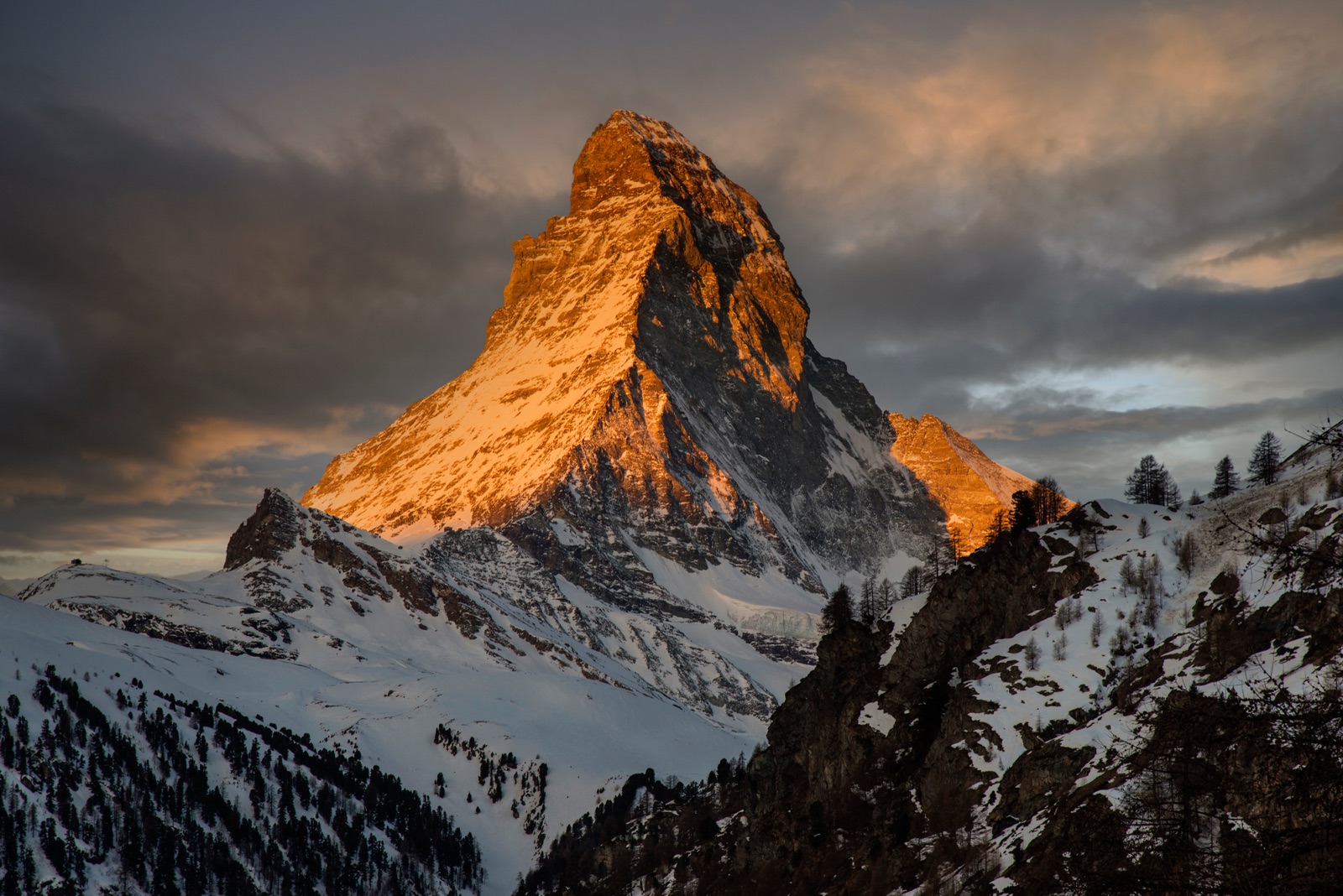
The evening light on the Matterhorn is spectacular, and you do not need a lift to enjoy it: the peak is visible from the village. Watching the last light turn the summit gold or pink is one of the great pleasures of a night in Zermatt, and it costs nothing.
How many days to allow
One day is enough to reach Zermatt and go up to one viewpoint — if the weather cooperates. It is a gamble.
Two days give you a second chance at a clear morning, or time for both viewpoints if the first day is good.
Three days or more let you relax: wait for the clearest morning for your chosen viewpoint, walk between the Gornergrat’s stations, visit the Glacier Palace, and see the Matterhorn at sunrise and sunset.
If you only have one day, a guided day trip from Lake Geneva is the simplest way to try. The day trip from Geneva takes about 13 hours, with free time in Zermatt; the tour from Lausanne takes about 11.5 hours and offers the Glacier Paradise cable car as an option. Remember that these long days leave limited time in Zermatt itself, and they cannot wait for the weather.
A three-day plan for the best chance
- Day one: arrive in Zermatt, settle in and watch the evening light on the Matterhorn from the village. Check the forecast.
- Day two: if the morning is clear, take the first Gornergrat train and walk down between the intermediate stations; if not, visit the Glacier Palace and the village, and keep watching the peak.
- Day three: go to whichever viewpoint you have not seen — or back to the one you missed in cloud — on the clearest morning you get.
The plan is deliberately flexible: its only fixed rule is to go up whenever the peak is clear.
Choosing your viewpoint for the conditions
Your choice of viewpoint can depend on the day.
- On a perfectly clear day: either. For the classic head-on view, the Gornergrat; for altitude, glaciers and the widest panorama, Glacier Paradise at 3,883 m, with its 38 four-thousand-metre peaks and 14 glaciers in three countries.
- If cloud is gathering at the very top: the Gornergrat, which looks at the Matterhorn from across the valley, may still give you views of the mountain’s lower faces when the summit is wrapped in cloud.
- If the high viewpoints are in cloud altogether: the Glacier Palace, 15 m below the glacier surface and open all year, is an experience that does not depend on the view. So is a walk in the village or a lower lift.
Our guide to Gornergrat or Glacier Paradise compares the two in detail.
What to do on a cloudy day in Zermatt
A day of cloud does not have to be a wasted day. Zermatt has plenty to offer when the Matterhorn is hiding.
- The Glacier Palace. Fifteen metres below the surface of the glacier at Glacier Paradise and open all year, it is one of the few high-altitude experiences that is just as good in cloud as in sun. Allow 30 to 45 minutes, and wear warm clothing.
- The village. Zermatt’s old quarter, with its dark timber chalets and narrow lanes, is worth a slow wander. Car-free streets make it a pleasant place to walk whatever the weather.
- A lower lift. The Sunnegga funicular is the shortest ride of the three and takes you to a lower viewpoint above the village, sometimes below the cloud.
- Watch and wait. Cloud on the Matterhorn can lift within minutes. Keep an eye on the peak from the village, and be ready to head for the Gornergrat valley station — directly opposite Zermatt station — if it clears.
- Plan the next morning. Check tomorrow’s forecast and aim for the first train if it looks clear.
Fitting the Matterhorn into a wider trip
Few visitors come to Switzerland for Zermatt alone. A few ways to build the Matterhorn into a longer journey:
- Arrive by rail. Trains run to Zermatt every half hour, about three and a half hours from Zurich Airport and four hours from Geneva or Basel airports, and you can also arrive on the Glacier Express. Rail makes it easy to add Zermatt to a Swiss itinerary.
- Put Zermatt in the middle of your trip, not at the end, so that a cloudy stay can be extended or revisited.
- From Lake Geneva, the guided day trips from Geneva and Lausanne are the simplest one-day option, but a night or two in Zermatt gives far better odds of a clear view.
- If you are driving, remember that you will leave the car at Täsch; the shuttle train runs every 20 minutes and takes 12 minutes into the village.
What to wear at the top
The viewpoints are far higher than Zermatt, and the temperature and wind change accordingly. The Gornergrat railway takes you from 1,604 m to 3,089 m; Glacier Paradise is at 3,883 m. Dress for the top, not the village:
- Warm layers. A fleece or light down jacket even in summer; full winter clothing in winter.
- A windproof outer layer. The platforms are exposed.
- Warm clothing for the Glacier Palace, where the operator recommends it — you are inside the ice.
- Sunglasses and sun cream. Snow and ice reflect strong sun at altitude all year.
- Sturdy shoes, especially if you plan to walk between the Gornergrat’s stations.
- Gloves and a hat outside the height of summer.
Altitude: take it easy
Glacier Paradise, at 3,883 m, is the highest mountain station in Europe, and most visitors arrive there within a short time of leaving the valley. At that height, some people feel light-headed or short of breath. A few simple rules help:
- Move slowly at the top, especially on stairs.
- Drink water.
- Come down if you feel unwell. Symptoms usually ease quickly at lower altitude.
- Consider the Gornergrat if anyone in your group is sensitive to altitude; at 3,089 m it is noticeably lower.
Photographing the Matterhorn
A few tips to come home with the picture you want:
- Be there early. Morning light and the absence of crowds make the first trains the photographers’ favourite.
- Use the intermediate stations. The lower stops on the Gornergrat line give different foregrounds — meadows, lakes, the railway itself — with the mountain behind.
- Include the train. The cogwheel train with the Matterhorn behind it is one of the classic compositions.
- Stay for the evening. The last light on the summit, seen from the village, is often the most dramatic picture of all.
- Keep watching. If cloud is covering the summit, wait: it can lift as quickly as it came.
A short history to take with you
Standing opposite the mountain, it helps to know its story. The Matterhorn was first climbed on 14 July 1865 by a roped party of seven that included Edward Whymper and Peter Taugwalder senior and junior, by the Hörnli ridge — the line you can see running up towards the summit from the Zermatt side, and still the standard Swiss route today. The standard Italian route follows the Lion ridge on the far side. High on the Hörnli ridge, at 4,003 metres, stands the Solvay Hut, an emergency bivouac for climbers.
Knowing that people climb that ridge — and that the first ascent was made there — changes how you see it from the viewing platforms.
Frequently asked questions
When is the best time of year to see the Matterhorn?
It can be seen in every season. Summer has the longest days, the full Gornergrat timetable (20 April to 1 November 2026) and summer skiing at Glacier Paradise (4 May to 31 October 2026); winter has the snow-covered mountain and the ski area. Clear skies matter more than the season.
What time of day is best?
Early morning is often best: the first Gornergrat train leaves Zermatt at 07:00 in summer, with fewer people and morning light on the mountain. Evening light can be seen from the village.
Is the Gornergrat railway open in November?
Not from 2 to 14 November 2026, when it is closed for construction work with no alternative transport. The summer timetable ends on 1 November.
How many days should I spend in Zermatt?
Two or three days give you the best chance of a clear morning and time for more than one viewpoint. One day works only if the weather is good.
What if the Matterhorn is covered in cloud?
Wait if you can — cloud can lift quickly. Otherwise, visit the Glacier Palace at Glacier Paradise, which is open all year and does not depend on the view, and try the viewpoints again another morning.
How high is the Matterhorn?
4,478 m. It was first climbed on 14 July 1865 by the Hörnli ridge.
Can I see the Matterhorn without going up a lift?
Yes. The peak is visible from Zermatt itself on a clear day, and the evening light on the summit, seen from the village, is one of the finest views of the mountain. The lifts bring you closer and higher, but they are not the only way to see it.